Culture – the way of life of a group of people passed down from one generation to the next through learning
Enculturation – learning our native culture(s) in childhood
Acculturation – adapting to another culture
Culture shock – the stress associated with acculturation

Wednesday, May 14, 2008

(Ir)regular people

"Clinton won tonight because this is a state that likes, you know, regular people."


Les voyages forment la jeunesse

Last fall I traveled to Iceland and France with an American friend, Jim. This was Jim's first trip outside North America - a vacation of a lifetime. For me, this was my annual pilgrimage to the fatherland with a fun, random weekend in Reykjavik tacked on (why Iceland? b/c Icelandair is cheap). As could be expected, Jim and I didn't turn out to be the most compatible of travel buddies. I'm a city girl who power walks to get places; he's a suburbanite who strolls for leisure. I like to find the off-the-beaten track, random nooks and corners of a city, whereas he understandably wanted to check out the big tourist stuff, which he wanted to photograph from every possible angle, using every possible setting on his camera. I, meanwhile, was perfectly content to wander around, taking in the sights, sounds and smells without trying to document the moment. I vividly remember admiring the neoclassical sculpture at the Louvre and having my precious moment ruined (from my perspective) by Jim sighing, "I'm not crazy about all this stuff, to be honest, but I didn't want to go back the States after a trip to France and not have been to the Louvre!" Meanwhile, I'm sure that my insistence on enjoying the moment, walking briskly, and eating strange foods while holding my cutlery in a specific way drove him equally crazy.
This "collecting proofs of experiences" attitude toward travel is something that has often perplexed me in my American friends and acquaintances. I remember being horrified by friends returning from a semester abroad with 9,000 digital photographs, which they assumed I would fascinated by (I was not). Just the other day another acquaintance was describing her desire to visit London "just to be able to say that she'd been there." I don't think this is a particularly American trait, even though I've mostly experienced it with Americans - but then again, these days I mostly interact with either Americans or TCKs who are just as blase about world travel as I am.
What is it about "being in the moment"? I think it's a combination of taking in the scenery, sounds and smells, of people-watching and seeing all the way in which they are familiar and foreign all at once, and of imaging what my life would be like and who I would be if I lived there.

Tuesday, May 13, 2008

The weaker sex?

More musings on the NYT article about love in Saudi Arabia...
"The nature of men is that men are more rational. Women are not rational. With one or two or three words, a man can get what he wants from a woman."
20-year-old Enad succinctly expresses his cultural belief that men are the strong, rational gender who can control their sexual urges, whereas women are weak and quick to give it up, requiring them to be kept under lock and key. Or at least that's my impression based on my (admittedly limited) knowledge of Saudi culture. Western parents keep tabs on their daughters too, but more out of a fear of predatory men than because they distrust their daughters.

Yesterday I attended a lecture by a Somali teacher and human rights defender, Hawa Aden Mohamed during which she addressed her uphill battle against female genital mutilation (FGM) in her country. I was absolutely astonished by the male justification she reported for this barbaric cultural practice: if women's sexuality wasn't kept in check by FGM, they would go around raping men and the society would descend into chaos. Basically like a reverse Congo.

I should say that I use the word "barbaric" en toute connaissance de cause, having weighed the pros and cons of using such a negatively charged term in a blog about intercultural communication. I am ready to accept cultural relativism about a host of things, but not everything - especially not what I consider universal human rights.

interculturalist in the FIELD


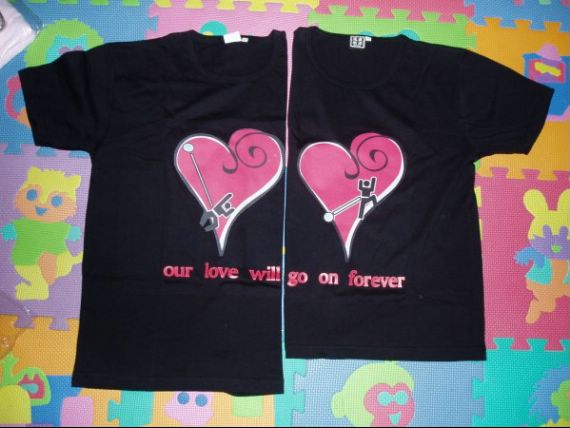
This weekend, I managed to snap two shots of these magical couples shirts. It was difficult being stealth, so in the end, I just surrendered and blatantly took a picture of two couples conversing. The couple on the left is wearing matching shirts, sneakers, AND jeans!

Cute? Gross? Qwaaa?

Monday, May 12, 2008

Love by any other name

Piggy-backing on Jenn's post about dating a la coreenne, did anyone read this article on the front page of today's New York Times? Check out the accompanying video and slideshow too.

I was struck by the contrast not only between Saudi tradition and the saccharine, Hollywood romance that the two young men depicted seem to idealize, but also with the cautious, almost reticent attitude among 20-something Americans. Nader isn't allowed to see or speak to his fiancee Sarah until the wedding, but she is in his cell phone as "My Love" and his ring tone is the Titanic theme song. In the video, Nader's cousin Enad talks about walking past his uncle's house and seeing his cousin without her veil, and falling in love at the mere sight of her. Never mind the incest part (for now), to my Western mind the idea of being in love after glimpsing someone once is preposterous. We Americans can date for months without considering ourselves "in love" - and even then, the etiquette of saying those three magic words without coming on too strong is a delicate balance.

Even compared to other Western cultures, the American dating scene is particularly cautious. A French friend of mind recently told that she had a new boyfriend whom she was very excited about. I congratulated her, and asked how long she'd been going out with this guy. "Since Saturday," she replied. This conversation happened on a Thursday. I know couples in the States who have been involved for months who don't consider each other boyfriend and girlfriend.

Even when that official status is achieved, usually fallowing a series of incremental steps (seeing each other, being involved, dating, being exclusive, being together, etc), both partners tend to be quite set on keeping their independence. No self-respecting American couple would ever wear matching t-shirts like in Korea, except maybe as a Halloween costume. Living together and/or engagement are seen as yet another momentous step, to only be undertaken after much thought and a deep conviction that you're "ready" and that you really have found "The One." We are a generation who has been told since birth that we could be, do and have it all, so our expectations for love are sky-high. "The One" has to be dreamily attractive, smart, hard-working, show potential to be a good parent, funny, share out interests and goals and "get us." Contrast that with Nader, who based his decision to marry Sarah (he was given the choice among his uncle's four daughters) because he'd seen her face as a child and remembered that she was pretty. In the West, that would be considered "crazy talk." Even Enad's idea of Western love - being engaged for six months and going out to dinner every night - is way on the conservative end of the spectrum of Western dating behavior. The norm is that you will date for at the very least a year before you get engaged, usually sleep together and maybe even cohabitate. My French relatives would think I was nuts if I announced my engagement to someone I wasn't living with (or at least moving in with imminently).

Diversity in med schools

I thought this article from Campus Progress (a Center for American Progress publication) was really interesting. So interesting, in fact, that I've been meaning to write about it since early May. First, it argues for affirmative action not as an issue of fairness but because diversity in the medical profession (and by extension, in many others) is in the public interest, and this is how:
One of the most important elements of comprehensive medical care is the relationship between a patient and his or her doctor, and research consistently
shows that this is an area where race and ethnicity have a significant, undeniable impact. Patients report higher measures of satisfaction and trust when their doctor is of the same race and ethnicity. One study found that race-concordant visits were longer on average and were characterized by more positive physician affect. In addition, minority physicians are more likely than white physicians to practice in geographic areas whose populations face multiple challenges to maintaining good health. The challenges that residents of these “underserved” areas typically face include poverty, lack of insurance, and shortages of physicians. Research has shown that access to health services for indigent populations is augmented by the presence
of minority physicians. And minority doctors report caring for more impoverished, uninsured and Medicaid-insured patients. For these reasons and others, it is clear that developing a diverse physician workforce would pay dividends across the health system, particularly given how many low-income and uninsured Americans lack needed care.

As I read this I am thinking of how the same dynamics apply to my own industry, the non-profit sector. In particular, it's interesting that financial risk seems to be the main reason non-whites stay away from careers in both medicine and non-profit work. For NGOs of course it's not so much a question of paying for school (though that can be a factor) as the lower salaries that non-profit employees can expect compared to their peers in the private sector.

Friday, May 9, 2008

The Custom Is Always Right?

On a recent trip to China, I met a 31-year-old man, let’s call him Sung Ryo, upon de-boarding my 2.5-hour Air China flight from Busan to Beijing. I had noticed him watch me in the Busan airport as I frantically tried to stuff my spring coat and reading material into my checked in luggage before checking in. I couldn’t tell if he was fixated on my appearance or rather how crazy I was acting (why would I put my plane-reading in my luggage rather than my carry on? I honestly don’t know the answer to that question either), but in any event, I was aware and familiar of him when I boarded in Busan.

We landed in Beijing in the early afternoon. As many of you know, Beijing has a new terminal full of tacky and amazing sights, and so many passengers, including Sung Ryo, got off the plane, pulled out their sleek Samsung powder pink cameras, and began snapping images of the graceful ceiling architecture and grand moving walkways of Terminal 3, the biggest building in the world. As I got off the walkway connecting the plane to the airport, I saw Sung Ryo awkwardly attempting to take a picture of himself with the new terminal. I walked up to him and asked (in Korean, all of our interactions were in Korean): “Do you want me to take your picture?”. Shocked that this doe-eyed (yes, I’m like a doe) creature could speak Korean, he immediately inquired “Are you Korean?” to which I responded, “No, I am American. But my mother is Korean and my father is American”. I suppose a simple “I’m American” answer could have sufficed in other places, but in Korea they remain inquisitive until they can understand every component of your background. Especially when you look as “confusing” (a Korean called me this once) as I do.

Anyway, Sung Ryo and I mounted this massive moving walkway and talked about these things in this order: how old I was, where I lived, what I did, and why I was in China. Five minutes of conversation was enough time for him to decide that he wanted my phone number, and so he asked—and observing that he was cute, well mannered, and funny, I gave it to him. He then asked to take my picture with his pink camera, and I shyly said “no” to which he responded with a giggle. He then told me that he would soon come up to my little town, and we would rent bicycles, ride them around a lake, and have a picnic of Korean sushi in the forest. Such a thought—of forced memories and frills--immediately sickened me, and though I am unquestionably both alone and horny, I suddenly wished that I had not given my number to Sung Ryo. Getting involved with a cute Korean boy was fine with me in theory, but in practice it would mean experiencing a whole new dating culture that was completely alien to me.

Korean dating is far less casual than American dating—and the act of giving him my phone number was indication I was seriously interested in becoming involved with him. Though I thought I had been acting reserved and shy, simple acts—such as waiting near him at the luggage carousel—had created a situation in which I was undeniably on the path to girlfriendhood as we parted ways at a busy Beijing taxi stand. He even said to me in Korean “we have only three months left together, but it will be wonderful”, a statement that shocked me twenty minutes later when I had finally translated it accurately.

I thought he had been pouring it on a bit strong just to charm me, and so I relaxed in China, somewhat excited (but also a bit concerned) about coming back to Korea for my first date/marriage with Sung Ryo.

When I landed back in Korea, I turned on my mobile to find three missed calls from him. “Wow is he enthusiastic and sweet!”, I thought to myself and planned to call him when settled back in my apartment, located about 1.5 hours away from the airport by shuttle. I fell asleep on the shuttle, and when I awoke there were yet another three missed calls from him as well as a text message that translated basically as “Do you know who this is? Why are you avoiding me?”, and a Multimedia text message with a photo of him making a heart shape out of his two hands. Oh blergh, whaaaaaaaat the fork. WHY?! Why can’t he just calm down and wait! WHY was he expecting a response immediately? WHY was he already being accusatory? WHY was there a picture of him in my inbox? WHY was he making a heart shape with his hands?

In the amount of time I took to process this (I slept on it), there were phone calls every other hour into the wee hours of the morning and text messages that become gradually more offensive. Most of the time he called and I was busy socializing with my host family or teaching in class, but sometimes I was actually not busy—and I saw his number calling, flipped out, and threw my phone under my pillow to drown out the ringing.

Sung Ryo had scared me on two interrelated fronts; one of which was excusable and the other, to me, was inexcusable. He scared me because he wanted to introduce me to a dating world, which was very unlike the American dating world to which I had been accustomed. The Korean dating world, of matching couples tshirts, rings, underwear, and proudly-naïve love made me want to barf. It was an experience soaked in dependence and smothering—two traits that I abhorred. However, being frightened of the Korean dating world (read: the unfamiliar) was no real excuse for me to avoid it, and so I probably should have gotten over my apprehension and at least given it a try. I didn’t have to marry the guy (though in his eyes, it certainly seems like we were headed down that path), nor did I even have to call him for subsequent dates. So this, in my mind, was the excusable front.

The second way in which he frightened me was, in some ways, typical to all Korean relationships—not exclusively dating—and this is the phenomenon of texting/phoning non-stop, and expecting the other party to reciprocate. In America, I am accustomed to waiting until I am free (or awake) to return a call, but in Korea, it seems, this behavior is considered very rude. Indeed, I was once watching a Korean talk show, and participants confessed that they bring their phones to the bathroom just so they can take any call that comes and respond immediately. Frequent calling would not annoy me per se, but it was the text messages that became progressively more offensive and accusatory that completely turned me off of Sung Ryo. Last night, he sent a message that warned me that if I did not call him back immediately, he would be very upset. He then sent me another text calling me very rude, and writing that my non-response was completely inexcusable and offensive. Following that was another text warning me that he would not be calling again. He then called twenty minutes later.

I understood his many messages and phone calls as desperate badgering, and I soon decided to ignore him all together by sending him a message saying that I already had a boyfriend in America, and I only wanted to be friends with him. Not an entirely mature way to handle the situation, I’m well aware, but I found no reason to get in touch with him when he had offended me with his thin threats and over-the-top persistence. Also, I was still scared about the Korean dating world, and this fear trumped all of my desires for companionship as I lead the lonely life of a teaching and research Grantee in the Korean countryside.

So how do you read this? Would he be undesirable in all cultures? Did I make a big mistake by even giving him my phone number? How could I have handled this better? Were my problems with Sung Ryo just indicative of my problems with men around the world? (Admittedly, I am a bit messed up in that area, even in America), And finally, after this column, could I be considered the half-Korean interculturalist Carrie Bradshaw?

Let me know what you think. More from me coming soon.