Culture – the way of life of a group of people passed down from one generation to the next through learning
Enculturation – learning our native culture(s) in childhood
Acculturation – adapting to another culture
Culture shock – the stress associated with acculturation

Showing posts with label Gender. Show all posts

Friday, September 26, 2008

Individual vs. group rights: virginity testing in South Africa

From the Washington Post:
"They must leave culture aside," Ngobese said. "Human rights are individual rights, which is not the way for us. We live communally."

Friday, September 19, 2008

NYT: Saudi women inspired by Oprah

From the article:
When “The Oprah Winfrey Show” was first broadcast in Saudi Arabia in November 2004 on a Dubai-based satellite channel, it became an immediate sensation among young Saudi women. Within months, it had become the highest-rated English-language program among women 25 and younger, an age group that makes up about a third of Saudi Arabia’s population.

In a country where the sexes are rigorously separated, where topics like sex and race are rarely discussed openly and where a strict code of public morality is enforced by religious police called hai’a, Ms. Winfrey provides many young Saudi women with new ways of thinking about the way local taboos affect their lives — as well as about a variety of issues including childhood sexual abuse and coping with marital strife — without striking them, or Saudi Arabia’s ruling authorities, as subversive.

Some women here say Ms. Winfrey’s assurances to her viewers — that no matter how restricted or even abusive their circumstances may be, they can take control in small ways and create lives of value — help them find meaning in their cramped, veiled existence.

“Oprah dresses conservatively,” explained Princess Reema bint Bandar al-Saud, a co-owner of a women’s spa in Riyadh called Yibreen and a daughter of Prince Bandar bin Sultan, the former Saudi ambassador to the United States. “She struggles with her weight. She overcame depression. She rose from poverty and from abuse. On all these levels she appeals to a Saudi woman. People really idolize her here.”

Sunday, September 14, 2008

Jamais trois sans quatre... (?)

I know I've been posting about this for the past three days, but I just can't get enough! Gender, anthropology and cross-cultural studies, all at once? Love it!

In addition to the article I keep linking to, John Tierney has a post up on his blog (the Tierney Lab Blog) on the topic. The post itself is essentially a paraphrasing of the "Findings" article, but the comments are pretty interesting. The vast majority are insightful and on-point, but the few truly dumb/insane ones are worth quoting:

So, does all this mean that if you answer the door and there’s a woman on the stoop dressed as a police officer with baton and cuffs in hand and a holstered pistol strapped to her waist you can still ask her for a date?

— John Brady

My… There are a lot of angry women out there stuck on all the ways life is unfair… I only wonder when a men’s movement will form to protest the injustices of education and preferential hiring and scholarship for women?

While this research may not be perfect, and like all research may leave more left unanswered than of seems to answer, I’m left feeling glad that despite the efforts of social engineering and feminism men and women are still maintaining some of their unique and special characteristics… maybe even emphasizing them! Could it possibly be that women’ salaries aren’t lower because of the evils of men, but because they took their positions for some other reason than money? Why should women get to be described with all the positive adjectives and get the same salaries as the aggressive and competitive males their forced to tolerate?

Women are women and men are men, for better or worse. As interesting as it is to explore and as enticing as it may be to change, we’re in the process of killing our planet and all the other beautiful forms of life on it… Can we turn our attention to that now?

— carver

What difference does it make? We’re all doomed. Have a nice day.

— Jagdish Collins
Possibly my favorite comment on ANY NYT blog, EVER :)

Saturday, September 13, 2008

More on negative correlation between gender equality and gender sameness

Come to think of it, if this stuff about gender differences becoming more pronounced as society becomes more egalitarian is true, that ought to shut up those geezers who are still claiming that women's lib is turning us into men. If anything, it's turning us into girly-girls.

Anyway, I just wanted to link to a few articles I've found on this topic:

Why Can’t a Man Be More Like a Woman? Sex Differences in Big Five Personality Traits Across 55 Cultures
Previous research suggested that sex differences in personality traits are larger in prosperous, healthy, and egalitarian cultures in which women have more opportunities equal with those of men. In this article, the authors report cross-cultural findings in which this unintuitive result was replicated across samples from
55 nations (N  17,637). On responses to the Big Five Inventory, women reported higher levels of neuroticism, extraversion, agreeableness, and conscientiousness than did men across most nations. These findings converge with previous studies in which different Big Five measures and more limited samples of nations were used. Overall, higher levels of human development—including long and healthy life, equal access to knowledge and education, and economic wealth—were the main nation-level predictors of larger sex differences in personality. Changes in men’s personality traits appeared to be the primary cause of sex difference variation across cultures. It is proposed that heightened levels of sexual dimorphism result from personality traits of men and women being less constrained and more able to naturally diverge in developed nations. In less fortunate social and economic conditions, innate personality differences between men and women may be attenuated.

Gender Differences in Personality Traits Across Cultures: Robust and Surprising Findings
Secondary analyses of Revised NEO Personality Inventory data from 26 cultures (N = 23,031) suggest that gender differences are small relative to individual variation within genders; differences are replicated across cultures for both college-age and adult samples, and differences are broadly consistent with gender stereotypes: Women reported themselves to be higher in Neuroticism, Agreeableness, Warmth, and Openness to Feelings, whereas men were higher in Assertiveness and Openness to Ideas. Contrary to predictions from evolutionary theory, the magnitude of gender differences varied across cultures. Contrary to predictions from the social role model, gender differences were most pronounced in European and American cultures in which traditional sex roles are minimized. Possible explanations for this surprising finding are discussed, including the attribution of masculine and feminine behaviors to roles rather than traits in traditional cultures.

A Cross-Cultural Analysis of the Behavior of Women and Men: Implications for the Origins of Sex Differences
This article evaluates theories of the origins of sex differences in human behavior. It reviews the cross-cultural evidence on the behavior of women and men in nonindustrial societies, especially the activities that contribute to the sex-typed division of labor and patriarchy. To explain the cross-cultural findings, the authors consider social constructionism, evolutionary psychology, and their own biosocial
theory. Supporting the biosocial analysis, sex differences derive from the interaction between the physical specialization of the sexes, especially female reproductive capacity, and the economic and social structural aspects of societies. This biosocial approach treats the psychological attributes of women and men as emergent given the evolved characteristics of the sexes, their developmental experiences, and
their situated activity in society.

Friday, September 12, 2008

Run, Forrest, run! Forrestina, not so much

As a follow-up to yesterday's post, another interesting finding from the same NYT article:

Competitive running makes a good case study because, to mix athletic metaphors, it has offered a level playing field to women the past two decades in the United States. Similar numbers of males and females run on high school and college teams and in road races. Female runners have been competing for equal shares of prize money and receiving nearly 50 percent more scholarship aid from Division I colleges than their male counterparts, according to the N.C.A.A.

But these social changes have not shrunk a gender gap among runners analyzed by Robert Deaner, a psychologist at Grand Valley State University in Michigan, who classifies runners as relatively fast if they keep close to the pace of the world’s best runners of their own sex. When Dr. Deaner looks at, say, the top 40 finishers of each sex in a race, he typically finds two to four times as many relatively fast male runners as relatively fast female runners.

This large gender gap has persisted for two decades in all kinds of races — high school and college meets, elite and nonelite road races — and it jibes with other studies reporting that male runners train harder and are more motivated by competition, Dr. Deaner says. This enduring “sex difference in competitiveness,” he concludes, “must be considered a genuine failure for the sociocultural conditions hypothesis” that the personality gap will shrink as new roles open for women.

Makes me feel better about my complete lack of interest in competitive sports. Sort of. (PS, apologies for the ridiculous title).

Thursday, September 11, 2008

NYT: As Barriers Disappear, Some Gender Gaps Widen

In the NYT's Science section on Monday,
When men and women take personality tests, some of the old Mars-Venus stereotypes keep reappearing. On average, women are more cooperative, nurturing, cautious and emotionally responsive. Men tend to be more competitive, assertive, reckless and emotionally flat. Clear differences appear in early childhood and never disappear.
....
For evolutionary psychologists, the bad news is that the size of the gender gap in personality varies among cultures. For social-role psychologists, the bad news is that the variation is going in the wrong direction. It looks as if personality differences between men and women are smaller in traditional cultures like India’s or Zimbabwe’s than in the Netherlands or the United States. A husband and a stay-at-home wife in a patriarchal Botswanan clan seem to be more alike than a working couple in Denmark or France. The more Venus and Mars have equal rights and similar jobs, the more their personalities seem to diverge.
...
These findings are so counterintuitive that some researchers have argued they must be because of cross-cultural problems with the personality tests. But after crunching new data from 40,000 men and women on six continents, David P. Schmitt and his colleagues conclude that the trends are real. Dr. Schmitt, a psychologist at Bradley University in Illinois and the director of the International Sexuality Description Project, suggests that as wealthy modern societies level external barriers between women and men, some ancient internal differences are being revived.

The biggest changes recorded by the researchers involve the personalities of men, not women. Men in traditional agricultural societies and poorer countries seem more cautious and anxious, less assertive and less competitive than men in the most progressive and rich countries of Europe and North America.

To explain these differences, Dr. Schmitt and his collaborators from Austria and Estonia point to the hardships of life in poorer countries. They note that in some other species, environmental stress tends to disproportionately affect the larger sex and mute costly secondary sexual characteristics (like male birds’ displays of plumage). And, they say, there are examples of stress muting biological sex differences in humans. For instance, the average disparity in height between men and women isn’t as pronounced in poor countries as it is in rich countries, because boys’ growth is disproportionately stunted by stresses like malnutrition and disease.

I remember reading somewhere that gender-specific dysmorphic disorders such as anorexia and the Adonysis complex (ie body building syndrome) tend to be more common in relatively egalitarian societies and groups. Otherwise put, the more men and women are socially equal, the more they try to differentiate each other physically by accentuating their secondary sexual characteristics. I wonder how that all ties in...

Friday, August 29, 2008

Muslim women and sports

There's been quite some discussion about Saudi Arabia's ban on female athletes competing in the Olympics. Owl's recent blog post on the tensions she's encountered as a "sporty Muslima" is an interesting contribution. Excerpt:
So why is this such a taboo in the minds of so many Muslims? Well, partly I think it’s a culture clash. I notice many questioners come from ethnicities or generations where women do/did little physical activity beyond child rearing and housework, which are worthy pursuits but currently not part of my life. The idea of women wanting or enjoying sport and fitness is as foreign to them as the idea of women wanting to stay in the home all the time is to my peers. It is simply an unknown to them and they are expressing their curiosity, which is fine. Most retain an open mind and have a willingness to understand, which we all need to have.

But the rest of the complainants are men of a certain bent - men who not only disapprove of my athleticism, but also my profession, my education, and my mind. And as they cannot easily forbid me from any of those – as Islam urges education equally and allows women to earn and own – they focus on my hobby. It strikes me as a control issue, and that saddens me. I am a much more fruitful contributor to my Ummah if I am capable, strong and empowered. To be a mindless subservient would make me drain instead of a boon, and though it would probably be easier to ‘control’ me that way, it would be at a cost of the energies of my ‘controller’ and of the actualization of my own potential.


Check out the blog itself for a breakdown of the religio-cultural arguments against women exercising.

Saturday, August 23, 2008

Quick hit from Jezabel

We've mentioned it before, but it bears repeating. ... [Always 'asking' For It]

We've mentioned it before, but it bears repeating. Many women in Egypt report being harassed by men, even when wearing the pictured niqab or the more common hijab. Seventy-two percent of the 83 percent of Egyptian women that reported being harassed say they were harassed while veiled. Conservative groups in Egypt are encouraging women to adopt hijabs or niqabs to avoid harassment, while some women say they gave it up entirely after experiencing so much harassment — and are harassed less without. Once again, the problem is never what the woman is wearing — or what she was drinking — it's what men feel inappropriately (or illegally) entitled to do about it. [Washington Post]

Saturday, August 9, 2008

Harassment, piropos and hollering back

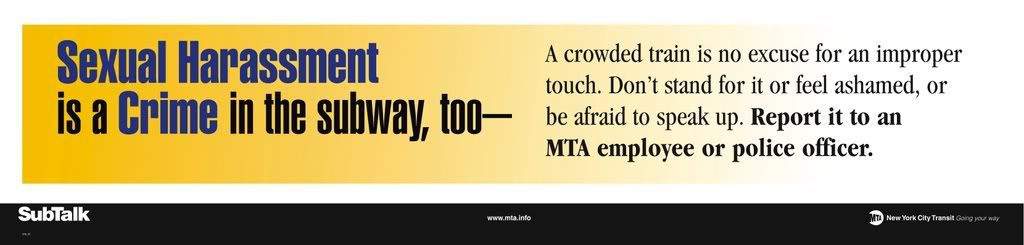
Feministing's first Friday Feminist Fuck Yeah highlighted the New York City MTA's new ads encouraging victims of random ass-grabbings and other forms of harassment to report it - the idea being that you wouldn't tolerate it at work or at school, you shouldn't have to tolerate it on your commute.


This made me think of my college study abroad in Santiago de Chile, when street harassment (called "piropos" in Chilean), along with other factors, drove me into a pretty serious depression. I actually put on a good 15 pounds in less than 4 months in a failed attempt to get males to stop noticing me. Notice that I say males, not just men. I once had an old man point me out as "potuta" (nice assed) to his 12 year old grandson. The kid then winked at me and yelled "chupamelo princesa" (suck me, princess). Abuelo beamed with pride.

That is no way to start a workday.

I eventually learned some profanities at my own - not that it changed anything, but it did make me feel better. What did not make me feel better was my host mom's indifference to my complaints - she told me that when I got to be her age (50) and lost my looks, I would wish that men still shouted piropos at me!

Has anyone had similar experiences? Do you think that public service ad campaigns like MTA's can help change the cat-call culture?

Tuesday, July 22, 2008

Catch-up week continues: moral vigilantes in yemen

Whoa. It took me so long to post this b/c I didn't know what to say. I still don't, but check out the article.

Sunday, July 20, 2008

Fighting gender-based violence, one woman at a time

Another post in the "I've been meaning to post this forever" category... Nora Boustany's WaPo article last month doesn't need comments from me.

Wednesday, June 25, 2008

Albania's sworn virgins

Fascinating article in the New York Times today about the Albanian "sworn virgin" tradition. According to Albanian custom, if the "patriarch" of a family dies without leaving a male heir, an unmarried (ie virginal) daughter or other relative can make an oath to remain a virgin for life and assume a male identity (though usually without changing her first name) and become the "man of the house," protecting and providing for the rest of the family. They live as men and are regarded as male by the rest of society, including other men.
The tradition of the sworn virgin can be traced to the Kanun of Leke Dukagjini, a code of conduct passed on orally among the clans of northern Albania for more than 500 years. Under the Kanun, the role of a woman is severely circumscribed: take care of children and maintain the home. While a woman’s life is worth half that of a man, a virgin’s value is the same: 12 oxen.
This is interesting on a number of levels. first, it implies (or so it seems to me) that women aren't inherently less capable than men since persons who are born women can fulfill male roles within society. Moreover, a woman doesn't lose her value until she becomes sexually active and a potential mother. This is different from other patriarchal models where virginity is valued because a woman becomes "ruined" by sex, and unfit for marriage to a different man, or where extramarital sex brings shame or dishonor onto her male relatives. This 2007 Washington Post article explains,
The idea that a woman would need to forsake love and live as a man to control her own fate seems primitive to modern eyes. But perhaps, in the context of a once-upon-a-time culture, a culture before feminism, it can be seen as progressive. The existence of sworn virgins reveals a cultural belief, however inchoate, that a biological woman can do all the work of a man.
Under this paradigm, biology may not be destiny but society is built around two completely separate gender roles. A person's gender role may usually be determined by biological sex, but that can be overridden by social imperatives.

Monday, June 16, 2008

Kristof on rape

Thank you, Nick Kristof for your column yesterday about rape as a weapon of war. The one thing missing from Kristof's column and the comments page on his blog is a thorough analysis of the motives behind mass rape. And for good reason: there is no way to conduct a scientific study (with focus groups and all) of guerilla rapists in the Congo. Additionally, the normal response to such evil acts is to condemn the evildoers along with their crimes, not to look them deep in the eyes and ask, how do you feel? why did that seem like a good idea? what's in it for you?
The scariest thing to me about deep evil is that those who commit it are usually convinced that they're doing the right thing - Hitler, Stalin, Mao and gang certainly did, and had a substantial body of literature (to use the term loosely) to back them up. I wonder, what set of beliefs, norms and values - ie, what culture - could make mass rape seem like the right thing to do?
The importance of misogyny can't be understated here - in cultures where women are seen as "less" than men in almost every way, violence against women is a way of life. And if you see your own wife as a piece of property or chattel that you can work, beat or rape as you please, it would follow quite logically that raping and mutilating another man's woman would be akin to painting a graffiti on someone else's house or keying his car.
In any war it's important to keep up your own troops' morale while demoralizing the enemy as much as possible. Raping and pillaging are pillars of that tactic, and if women are seen as property, abusing and destroying them is akin to burning down a house, poisoning a well or gutting a goat. In societies where a family's honor is linked to the sexual purity of its women, as is the case in much of the Muslim world, this is all the more devastating to the men. It's in large part for that reason that male-on-male rape is becoming more common in conflicts around the world.
The existence of a myth that sex with a virgin cures AIDS is well-documented. It's impossible to know how much that factors into the horrors in the DRC, but it's plausible that that would be a factor. I haven't seen The Greatest Silence yet - still working up the courage to watch it - but I remember reading a quote from one of the self-confessed rapists interviewed. The quote said something about how having sex with lots of women was a crucial component of a very powerful magic that brings men strength and courage in battle. Think "eating human flesh will make me invincible," a la Idi Amin, but with rape instead. There is very little literature on this topic, but it's certainly something I would like to learn more about. Finally, it's likely that a number of these soldiers/guerrillas fighters are drugged up - that seldom leads to restraint or humanity.
Before someone accuses me of excessive cultural relativism let me make something clear - rape, torture, mutilation and murder are always wrong. It is always wrong to take complete control over another person and use him or her as an object. But condemning an act or a way of thinking doesn't mean that we shouldn't try to understand the motivations behind the Other's acts.

Tuesday, June 10, 2008

Hymen reconstruction debacle grips France

Gynecologists report that in the past few years, more Muslim women are asking for certificates of virginity to provide proof to others. That in turn has created a demand among cosmetic surgeons for hymen replacements, which, if done properly, they say, will not be detected and will produce tell-tale vaginal bleeding on the wedding night. The service is widely advertised on the Internet; medical tourism packages are available to countries like Tunisia where it is less expensive.
And even more baffling...
The groom, an engineer, applied for an annulment because his bride, a student nurse, had lied to him about her virginity. Under the French civil code, an annulment can be granted “if there was a mistake about the person or the essential qualities of the person”. The judge declared the marriage void since it was “founded on a lie about her virginity”, which the bride acknowledged, and this constituted an “essential quality” in the eyes of both parties. The bride did not contest the annulment.
1) Women should have the right to pay for whatever ridiculous surgeries they want
2) Women should not be pressured into having ridiculous surgeries
3) Since it's well-established that all sorts of things can lead to the hymen rupturing, why is the presumption that a hymen-less woman isn't a virgin?
4) What's so great about virginity, anyway? Thanks to birth control and paternity tests, men don't have to worry so much about being duped into raising kids who aren't their own. And fears of STDs go both ways. If anything women should be more concerned, given the number of STIs that don't have any symptoms in men but can really mess up a woman's reproductive system.
5) In the case of the woman whose fiance's conservative Moroccan family wants their family friend to examine her, isn't that a form of assault? You better believe that no one looks at my lady parts without a good medical or romantic reason. And there's no way I'd marry anyone who tells me otherwise.
6) If you can't trust a woman to tell you the truth about her virginity and need so much proof, how can you trust her to be your wife? Or, why marry someone you don't trust?
7) Thats a LOT of money to pay for something whose sole purpose is to be examined once or twice and then broken. Kind of like a Jewish bride buying a fine crystal glass just to have the groom stomp on it.

So what does French public opinion have to say? That the husband in the Lille case was too young (23) to be taken seriously, that his virginity fetish was a throw-back to the Middle Ages (regardless of his religion), and that doctors and judges who go along with this sort of thing are complicit to the oppression of women. I don't disagree with Halimi on any of those points, a priori, but I think there's probably more nuance to be found. I'd love to see articles written from either the husband or the wife's perspective, rather than from the perspective of a detached observer.

His & Hers - Nature or Nurture?

I've never been married nor lived with anyone, but I definitely agree with the generalizations about heterosexual relationships described in this NYT article. Both the data and anecdotal evidence from my coworkers, mentors and other couples I know strongly support the idea that women do the brunt of the housework, men make more money (and if they don't, they wish they did), she wants to talk more and he wants sex (I'm guessing a bit on those last two). Even when both partners say they want an egalitarian relationship, more often than not it just doesn't happen, and I think it boils down to deep-rooted expectations of who little boys and girls should grow up to be. As theoretically egalitarian as I am, I expect myself to cook and keep house well, and my guy friends tell me that they expect themselves to earn enough to support their eventual wife and kids - whether or not your partner actually expects that of you. There's also an element of "gee-wouldn't-it-be-nice if I could afford to stay home with the (theoretical) baby for a year or two", or "if the brilliant, talented woman I marry also happens to be a gourmet chef with Penelope Cruz's looks."
it's good to know that it isn't necessarily biologically-based. It's also reassuring that in my experience marriages get more egalitarian with each generation. My parents' marriage was more egalitarian than either of my sets of grandparents', and I'm much more comfortable with the idea of an egalitarian relationship than my parents are. For example, my dad thinks I should clean my apartment more thoroughly to get in the habit before I have a mother-in-law (who will judge mu suitability as a wife and mother based on that), and my mom thinks it's improper to call boys on the telephone - apparently that's "brassy". Oh and if anyone who speaks "Mom" can tell me what "brassy" means, that would be great.

Friday, May 23, 2008

And sexism, too!

Lest I be accused of being politically biased, props to the Washington Post for their article about the sexist attacks against Senator Clinton. The craziest thing to me is that the primary is supposed to be between democrats - if I didn't know better, I'd think that this primary was a referendum between sexists and racists.

Tuesday, May 13, 2008

The weaker sex?

More musings on the NYT article about love in Saudi Arabia...
"The nature of men is that men are more rational. Women are not rational. With one or two or three words, a man can get what he wants from a woman."
20-year-old Enad succinctly expresses his cultural belief that men are the strong, rational gender who can control their sexual urges, whereas women are weak and quick to give it up, requiring them to be kept under lock and key. Or at least that's my impression based on my (admittedly limited) knowledge of Saudi culture. Western parents keep tabs on their daughters too, but more out of a fear of predatory men than because they distrust their daughters.

Yesterday I attended a lecture by a Somali teacher and human rights defender, Hawa Aden Mohamed during which she addressed her uphill battle against female genital mutilation (FGM) in her country. I was absolutely astonished by the male justification she reported for this barbaric cultural practice: if women's sexuality wasn't kept in check by FGM, they would go around raping men and the society would descend into chaos. Basically like a reverse Congo.

I should say that I use the word "barbaric" en toute connaissance de cause, having weighed the pros and cons of using such a negatively charged term in a blog about intercultural communication. I am ready to accept cultural relativism about a host of things, but not everything - especially not what I consider universal human rights.